


Every Azure architect knows the frustration when generic certification training leaves real business challenges unresolved. Managing production infrastructure across multinational environments demands expertise that standard Microsoft courses cannot provide. Custom technical training offers focused skill development shaped around your team’s actual infrastructure patterns, helping your architects build independent ownership and avoid costly vendor lock-in. This approach translates theory into operational competence, letting your team truly drive mission-critical decisions.
Table of Contents
Key Takeaways
| Point | Details |
|---|---|
| Custom Training Is Essential | Generic training approaches do not meet the specific needs of organizations and often leave architects unprepared for real-world decisions. |
| Focus on Relevant Scenarios | Effective training should address the unique architectural decisions and governance requirements that teams face on a daily basis. |
| Empower Decision-Making | Training should empower architects to make confident, independent decisions rather than relying on external validation or consultancy. |
| Mitigate Vendor Lock-In Risks | Architects need training that emphasizes making informed technology choices to prevent costly lock-in situations in the future. |
Custom technical training for Azure architects
Standard Microsoft certification tracks miss what actually matters when you’re responsible for production infrastructure at scale. I’ve watched architects spend months grinding through generic Microsoft Learn modules only to hit real architectural decisions they weren’t prepared for, governance conflicts, landing zone trade-offs, network isolation complexity. Generic training doesn’t build the judgment needed for those calls.
Custom technical training bridges that gap. It’s built around your organization’s infrastructure patterns, your team’s skill levels, and the specific decisions you face daily. This isn’t about watching videos; it’s about structured learning that turns into operational competence.
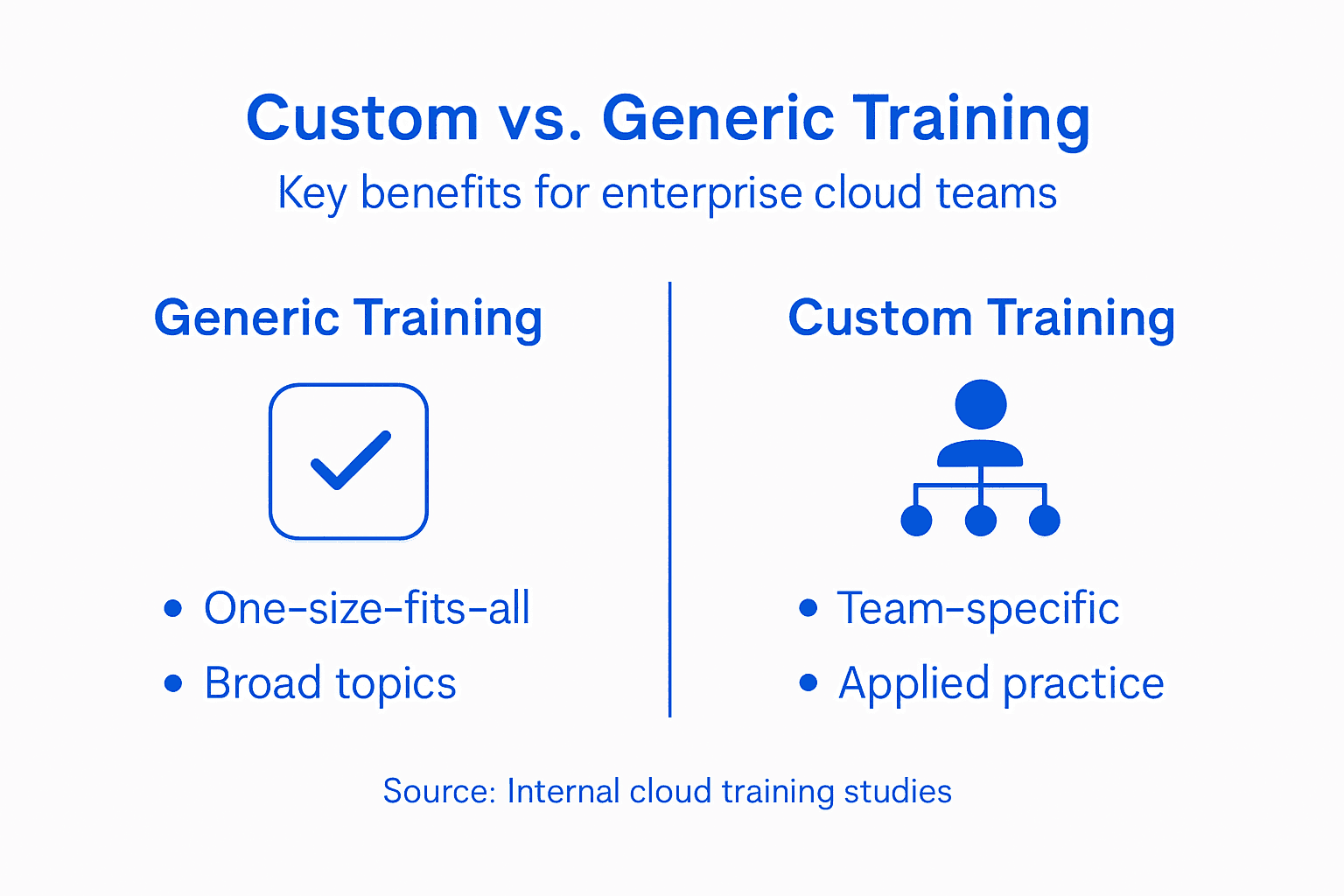
Here’s a comparison of generic versus custom Azure architect training and their impacts:
| Aspect | Generic Training | Custom Training |
|---|---|---|
| Content Relevance | Platform-focused, broad | Tailored to business needs |
| Decision Support | Limited for real scenarios | Targeted for daily decisions |
| Skill Application | Often theoretical | Directly operational |
| Team Ownership | Escalation to experts common | Fosters independent ownership |
Why Generic Training Fails Production Teams
Microsoft’s official pathways are broad by design. They cover the platform, not your platform. An architect at a financial services firm managing regulatory compliance needs different depth than one building SaaS applications. A team standardizing on infrastructure-as-code practices needs different focus than teams just migrating servers.
Here’s what breaks down:
Coverage gaps: Microsoft Learn covers features, not architecture trade-offs your team encounters
Pace mismatches: Generic courses move too slow for experienced architects, too fast for junior ones
Relevance gaps: Examples use sample scenarios, not your actual naming conventions, tagging strategies, or governance constraints
Application gaps: Architects complete training but struggle applying it to existing infrastructure
Generic training teaches the platform. Custom training teaches your business using that platform.
What Custom Training Actually Addresses
When I design custom architecture training, I start by mapping the decisions your team makes repeatedly. These are the high-consequence calls that determine whether infrastructure scales cleanly or requires expensive rework later.
For instance, Azure architecture patterns need context. A landing zone design that works for a company with three business units fails for one with twelve. Custom training embeds your specific scale, your actual subscription strategy, and your governance requirements into the learning.
The best custom programs cover:
Architectural decisions specific to your infrastructure scale and complexity
Governance implementation tied to your actual compliance requirements
Integration patterns matching your existing systems and migration timeline
Team-specific skill gaps identified through real architecture reviews
Hands-on labs built around problems your team has actually solved
Building Training That Sticks
Effective custom training combines structured instruction with applied problem-solving. Your architects need to see the principle, then immediately apply it to scenarios they recognize.
A three-day program focused on landing zone architecture, for example, might start with how zone principles address your specific scale and compliance constraints. It moves into your actual subscription topology, then into the decisions your team needs to make about compute isolation, network topology, and identity integration. The final day involves your architects working through a redesign of an existing zone, real application, real feedback.
This approach produces architects who can own future decisions, not ones who need to escalate every design choice.
Pro tip: Map your team’s architectural decisions over the past six months before designing training; the patterns you find are exactly what your custom program should address.
Tailoring skill development to enterprise needs
I’ve worked with enterprise teams that had no shortage of training budget. The problem was consistently the same: architects completing course after course but still escalating routine infrastructure decisions because nothing they studied mapped to their actual governance model, their subscription strategy, or the regulatory constraints shaping every call they made.

Tailored skill development isn’t a luxury. It’s the only way to build a team that owns decisions instead of escalating them constantly. Generic training teaches the platform. Tailored programs teach your business using that platform.
The Cost of One-Size-Fits-All Training
Enterprise teams have wildly different infrastructure complexity. A firm with ten Azure subscriptions managing regulatory compliance faces different challenges than one with fifty subscriptions handling application scaling. A team that recently migrated workloads needs different depth than one building new cloud-native services.
Generic training ignores these differences entirely. It treats all architects the same regardless of their experience, their infrastructure scale, or the specific decisions they’re responsible for making.
This creates real gaps:
Junior architects sit through advanced topics they can’t yet apply
Experienced architects waste time on foundational material they already know
Nobody learns how decisions should map to your specific infrastructure patterns
Training completion rates don’t improve operational capability
Tailored training aligns learning with the decisions your team actually makes.
Building Programs Around Your Business Reality
Strategic talent development works when it matches organizational goals, not when it follows a standard curriculum. Your infrastructure has unique characteristics. Your governance requirements are specific. Your team’s skill gaps are identifiable through actual architecture reviews.
When I design tailored programs, I start here:
Team assessment: What decisions do your architects make repeatedly? Where do they escalate?
Infrastructure mapping: What’s your subscription topology, compliance scope, and operational model?
Gap identification: Where does your current capability fall short of your infrastructure requirements?
Role alignment: What does each architect need to own independently?
This foundation determines everything. A security architect managing identity isolation needs different content than a platform architect designing compute strategies.
Creating Learning That Transfers to Operations
Effective tailored training bridges theory and practice immediately. Your architects learn a principle, then apply it to a scenario they recognize.
Consider landing zone architecture. Generic training explains landing zone concepts. Tailored training walks your architects through your specific zone decisions, your subscription topology challenges, and the integration points that matter in your environment. The final exercise involves redesigning an actual zone, applying learning directly to the infrastructure they own.
This approach creates architects who drive decisions forward independently, not teams that treat training as a checkbox.
Below is a summary of key training strategies and their business outcomes:
| Training Strategy | Key Action | Business Outcome |
|---|---|---|
| Role Alignment | Match content to job roles | Reduces unnecessary escalation |
| Hands-On Labs | Simulate real team challenges | Improves operational readiness |
| Governance Integration | Embed company policies | Ensures regulatory compliance |
| Flexibility Planning | Teach migration and exit options | Minimizes long-term vendor risk |
Pro tip: Interview three senior architects about their most challenging recent decision, and that decision becomes your training’s central case study, ensuring immediate relevance.
Empowering teams for independent operation
The moment your team stops escalating decisions to consultants or vendors is the moment your infrastructure starts scaling efficiently. I’ve watched organizations sink hundreds of thousands into cloud infrastructure only to remain dependent on external expertise for routine architectural decisions. That dependency is expensive and unsustainable.
Real empowerment means your architects own decisions confidently. They understand the trade-offs, the constraints, and the long-term implications. They don’t need permission or external validation for infrastructure changes.
Why Most Teams Remain Dependent
Dependency happens gradually. A team learns the platform through vendor-led training, completes certifications, and still feels uncertain about architectural decisions specific to their environment. Generic training creates knowledge gaps, not about Azure features, but about applying those features to your actual business constraints.
The result? Your team calls in consultants for decisions they should own independently. Your infrastructure decisions get delayed. Your operational costs climb because you’re paying for external expertise on routine work.
This breakdown typically shows as:
Architects hesitant to redesign landing zones without external validation
Governance policy decisions escalated to outside experts
Network architecture concerns treated as high-risk decisions requiring consultant approval
Operational runbooks that lack internal ownership
Independence isn’t about removing expertise; it’s about moving that expertise inside your team.
Building Knowledge Deep Enough for Ownership
For architects to own decisions independently, they need more than platform knowledge. They need technical enablement that connects Azure capabilities directly to your infrastructure patterns, your governance model, and your operational constraints.
This means training that addresses real questions your team faces:
Governance decisions: When do you implement policies? How do they scale across your subscription topology?
Architecture trade-offs: When do you choose one design pattern over another given your specific compliance requirements?
Operational integration: How do your infrastructure decisions integrate with existing systems and processes?
Risk assessment: What architectural choices create technical debt versus future flexibility?
When architects understand the reasoning behind these decisions in their context, they stop needing external validation.
From Training to Sustained Independence
Effective empowerment requires ongoing access to expertise, not just initial training. Your architects need to know where they can validate decisions as their infrastructure evolves.
This takes two forms. First, structured training that addresses your specific architectural patterns. Second, access to senior expertise that can answer emerging questions as your infrastructure grows. Your team learns the framework, applies it independently, and knows when to escalate genuine complexity.
Architects who understand their infrastructure at this depth move faster and make better decisions. They stop asking permission and start driving infrastructure forward.
Pro tip: After training, assign one architect to lead the first major architectural decision independently while a senior architect reviews the approach, which bridges learning to operational ownership.
Reducing vendor lock-in and costly mistakes
I worked with a manufacturing company that built its entire Azure infrastructure around proprietary services. Five years later, pricing changed, feature support shifted, and their infrastructure strategy became untenable. Migrating off those services required a complete redesign and months of disruption. They’d locked themselves in without realizing it, not through bad intentions, but through years of optimizing for speed over portability.
Vendor lock-in isn’t always intentional. It happens when you optimize purely for speed or vendor recommendations without considering long-term flexibility. Custom training teaches your team to see these traps before they become expensive.
How Lock-In Creates Costly Mistakes
Vendor lock-in in cloud computing results from proprietary technologies, incompatible services, and contractual restrictions. It limits your flexibility and increases costs over time. When your architecture depends entirely on vendor-specific features, you lose the ability to negotiate or migrate.
The real cost compounds. Your team makes architectural decisions based on convenience rather than portability. Your exit costs skyrocket. Your negotiating power disappears.
Lock-in typically manifests as:
Proprietary data formats that resist migration
Tightly coupled architectures dependent on specific vendor services
Contractual terms that penalize early exit or workload movement
Skills concentrated in vendor-specific technologies with limited market transferability
Smart architecture today prevents expensive lock-in tomorrow.
Building Architectures for Flexibility
Your team needs to understand which technology choices create lock-in and which preserve flexibility. This isn’t about avoiding all vendor services; it’s about making intentional decisions.
Effective approaches include:
Infrastructure as code: Portable definitions that can move between environments
Containerization: Applications that run consistently across platforms
Open standards: Technologies with multi-vendor support reduce single-vendor dependency
Exit planning: Knowing the cost and timeline to migrate before you need to
Decoupled design: Components that can be replaced independently
Architects trained in these patterns make better early decisions. They design for portability while maintaining performance. They avoid the expensive redesigns that come later.
The Real Cost of Lock-In Prevention
Preventing lock-in requires thoughtful design upfront. It takes more time than the fastest proprietary path. But the flexibility you preserve is worth far more than the time investment.
Consider a company standardizing on open container approaches versus proprietary serverless services. The container approach requires more operational overhead initially. But five years later, when they need to negotiate with their vendor or migrate workloads, they have options. The company locked into proprietary services does not.
Your team needs training that connects these architecture decisions to real business outcomes, not just technical recommendations.
Pro tip: Before adopting any new Azure service, ask your architects: “If we needed to migrate this workload in three years, what would the cost and effort be?” This single question surfaces lock-in risks early.
Security, governance, and compliance outcomes
A compliance audit found that one enterprise’s Azure environment violated its own governance policies in seventeen different ways. Nobody had enforced those policies. Architects made decisions freely without understanding the compliance constraints they were supposed to follow. The organization faced potential audit failures and regulatory exposure, all preventable through proper training.
Custom training transforms security and governance from theoretical requirements into operational reality. Your team learns not just what policies exist, but why they matter and how to implement them consistently.
Why Generic Security Training Misses Critical Gaps
Standard compliance training teaches regulations and frameworks. It doesn’t teach your specific governance model or how to enforce it across your infrastructure. Your architects can pass compliance courses without understanding how your policies apply to the decisions they make daily.
The disconnect creates real problems. Policies exist on paper but aren’t enforced. Architects work around governance because they don’t understand its purpose. Compliance becomes something security does, not something architecture owns.
This breakdown typically shows as:
Policy creation without clear technical implementation paths
Architects designing around governance instead of within it
Security reviews becoming bottlenecks instead of checkpoints
Compliance gaps discovered during audits rather than prevented
Effective governance requires architects who understand it, not just security teams who enforce it.
Connecting Policy to Architecture Decisions
Implementing and managing cloud governance policies means translating regulatory requirements into technical controls. Your architects need to understand when policies apply, how to implement them, and what trade-offs exist.
This requires training that covers:
Policy design: How your specific compliance requirements translate to Azure policies
Implementation patterns: Deploying policies in ways that scale across your infrastructure
Exception handling: When policies need to bend and how to manage that safely
Monitoring and enforcement: Detecting violations before audits find them
Team accountability: Making architects responsible for compliance outcomes
When architects understand these connections, governance becomes part of their design thinking, not an obstacle to work around.
Building Teams That Own Compliance
Compliance ownership requires more than policy knowledge. Your architects need to see how security and governance decisions affect operational efficiency and business outcomes.
Effective custom training addresses real scenarios your team faces. How do you implement identity governance across multiple business units? How do you enforce network isolation without blocking legitimate business needs? How do you audit compliance without creating administrative overhead?
Architects trained this way drive compliance forward proactively. They design for security from the start rather than patching problems later. Your audit results improve. Your operational risk decreases. Your infrastructure becomes genuinely compliant, not just nominally compliant.
Pro tip: Have security and compliance leaders participate in training design, they’ll ensure the policies covered actually matter to your audit requirements rather than generic frameworks.
Training That Fits Your Environment
Struggling with generic training that falls short of preparing your architects for real-world Azure decisions? The article highlights common pain points, such as a lack of relevant governance integration, an inability to apply platform knowledge to your unique infrastructure, and costly vendor lock-in. These challenges can lead to rushed decisions, increased audit risks, and costly rework. IronByte Consulting & Training delivers precisely what your enterprise needs: custom technical training tailored to your specific Azure environment, governance models, and operational realities.
Discover how our Technical Enablement offerings create tailored programs that foster architectural ownership and security compliance at scale. With over 20 years of senior-level cloud expertise, IronByte helps your team move beyond theory to confidently own critical infrastructure decisions while minimizing vendor lock-in risks. Ready to transform your cloud capabilities and reduce costly mistakes? Acting now ensures your enterprise gains the strategic edge to scale efficiently. Visit IronByte Consulting & Training to explore how our custom training and consulting can align your architects with your business goals and mission-critical infrastructure.
Frequently Asked Questions
What is custom technical training for Azure architects?
Custom technical training for Azure architects is a tailored educational program designed to address the specific architectural needs and challenges of an organization. It focuses on real-world scenarios and decisions that architects face daily, enabling them to apply their learning directly to their operational environment.
How does custom training differ from generic training?
Custom training is tailored to an organization’s unique infrastructure patterns, governance requirements, and skill gaps, whereas generic training provides broad platform knowledge without focusing on specific business contexts or decision-making scenarios. This makes custom training more relevant and applicable for team members.
Why do teams struggle with generic Azure training?
Teams often struggle with generic Azure training because it covers features instead of architectural trade-offs and may be paced inconsistently with the varying skill levels of team members. This can lead to knowledge gaps and difficulties in applying concepts to actual infrastructure challenges.
What are the benefits of implementing custom training for cloud architects?
Implementing custom training empowers cloud architects by enhancing their decision-making capabilities, promoting independent ownership of infrastructure design, improving operational efficiency, and ensuring compliance with governance policies. This leads to better decision-making processes and reduced reliance on external consultants.
