


Your IaC can be automated, functional, and still not be governed.
Industry: SaaS
Team shape: A small infrastructure team supporting a much larger development organization
Duration: 6 months
Engagement: Governance & Security, Workload Automation & Optimization
Key results:
- ~70% reduction in typical end-to-end deployment cycle time (approved change → production)
- ~90% of existing workload logic migrated into a standardized module set
- One governed Bicep module standard, replacing the individual variants each engineer had built
The Challenge: Invisible Inconsistency
This client wasn’t running ClickOps. They were already deploying entirely through Infrastructure as Code (IaC), which is exactly why the problem was hard to see.
Each engineer had built their own Bicep modules, in their own style, over time. There was no shared module registry, no enforced parameter standard, and no tracking of which version of which module was running where. The code was real. The consistency wasn’t.
As the engineering team grew, that divergence compounded, module by module and parameter by parameter, until two deployments built from “the same” template could no longer be assumed to behave the same way.
What this put at risk:
- Hidden governance gaps. Infrastructure looked operational from the outside, but unexplained differences could go unnoticed until they caused a real problem.
- Onboarding drag. New engineers had to learn whichever individual’s pattern a module happened to follow, not a single company standard.
- A scaling ceiling. The client was preparing for real growth, and per-engineer IaC patterns multiply friction with every new engineer and workload.
- No accountability trail. Tracing an unexpected change back to its source was a manual, engineer-dependent exercise.
The Strategy: The CROCS Framework
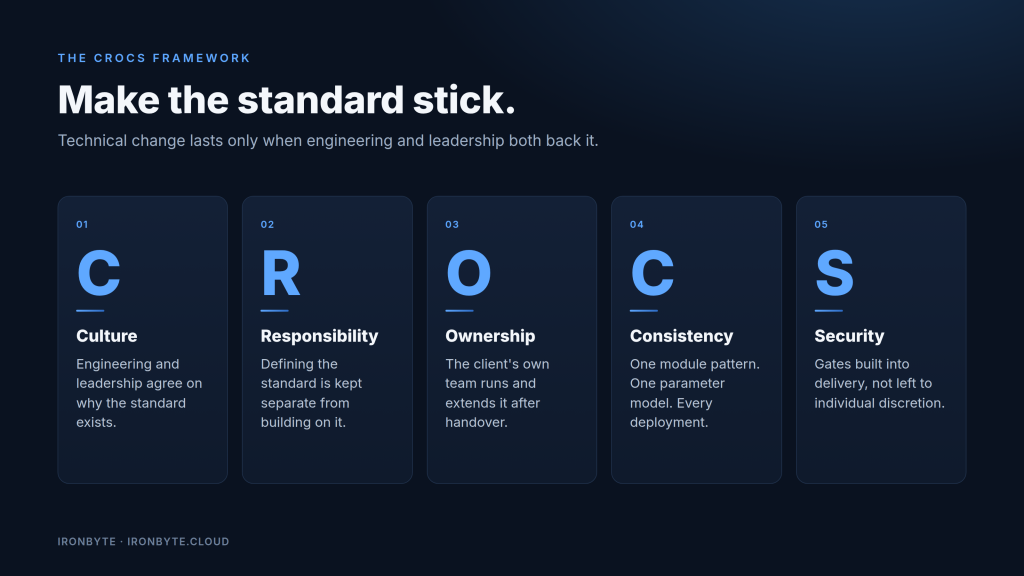
The engagement was structured around IronByte’s CROCS framework, framed for this client’s situation. A governance shift that only engineers believe in tends to erode the moment the team changes, so CROCS makes sure the standardization effort is understood and backed by leadership as well as engineering.
- Culture: Aligning engineering and leadership on why standardization enables speed rather than restricting engineers’ autonomy.
- Responsibility: Separating who defines the module standard from who writes feature code against it.
- Ownership: Structuring the architecture and its documentation so the client’s own team can extend it long after the engagement ends.
- Consistency: One governed Bicep module pattern and parameter model, replacing several individually reasonable but mutually inconsistent approaches.
- Security: Policy and review gates built into the delivery process, not left to individual discretion.
The Execution
Rather than layering automation onto the existing environment, IronByte architected a greenfield Azure Landing Zone with Bicep and Azure DevOps, designed to carry the client’s growth rather than require another rebuild at the next stage of scale.
Operationally, this moved the client from an environment where every engineer could build and deploy infrastructure differently to one with a single, supported deployment standard. The Landing Zone separates the platform layer, which holds governance, policy and shared foundations, from the workloads that run on top of it. Automation wasn’t added afterwards. Workloads enter the platform through standardized modules, one parameterization model and governed Azure DevOps pipelines, so the standard is enforced by how deployment works, not by engineers remembering to follow it.
Roughly 90% of the client’s existing workload logic was converted into the new standardized modules rather than rebuilt from scratch. That was harder than a typical retrofit: the original modules carried more parameters and more conditional branching than a mechanical port could handle. But the logic was real, working business behavior. Rewriting it would have meant reimplementing production-critical behavior from memory instead of from what was actually running, and reintroducing exactly the risk the engagement was meant to remove.
What Changed
| Before | After |
|---|---|
| Engineer-specific Bicep modules | One shared, governed module standard |
| Parameters structured differently by each engineer | A single parameterization model |
| Limited traceability of what was deployed where | Governed CI/CD through Azure DevOps |
| Environment constrained by fragmented deployment patterns | Greenfield Landing Zone designed to support future growth |
| Security practices left to individual engineers | Policy and review gates built into the delivery process |
The most visible result: standardizing the module and parameterization model cut the typical end-to-end deployment cycle, from approved change through production, by approximately 70%. Deployments now take roughly a third of the time they used to.
The speed is the headline, not the whole story. The infrastructure team moved from each engineer maintaining their own patterns to owning one standard that every deployment is checked against. Onboarding a new engineer now means learning one way of doing things, not one per colleague.
Why a Greenfield Landing Zone Instead of Incremental Fixes?
Patching individual modules in place would have fixed today’s inconsistency without fixing the structure that produced it. The next engineer, and the next workload, would have started the divergence again. A Landing Zone moved governance from individual habit into the platform itself, so consistency no longer depends on every engineer making the same choices.
If your team deploys through IaC but no two engineers write it the same way, that’s worth a conversation. IronByte’s Architecture Integrity Review is a structured starting point, or book a technical briefing to talk through your own environment.
